If you could get only one training variable right for muscle growth, weekly volume would be a strong pick: the number of hard sets each muscle gets per week. Do too few and you leave growth on the table. Do too many and you pile up fatigue without extra gains.
Here's what the research says, how to count your sets properly, and how to find the right number for you.
What the research says
More sets, more growth
The landmark 2017 meta-analysis on this question pooled 15 studies and found a graded dose-response relationship. Each additional weekly set was associated with a 0.37 percent greater gain in muscle size, and higher-volume groups gained about 3.9 percentage points more than lower-volume groups. When the studies were sorted into three bands, 10 or more weekly sets per muscle showed a trend toward more growth than 5 to 9 sets or fewer than 5.[1]
A 2019 study in trained men then compared one, three and five sets per exercise, done three times a week for eight weeks. Strength and muscular endurance improved similarly in all three groups, but the biceps and thighs grew more in the higher-volume groups, most clearly with five sets.[2] Strength and size clearly respond to volume differently, one reason programs for each goal look different; our article on strength vs. hypertrophy training explains why.
But the returns diminish
More isn't better forever. A 2022 systematic review found no clear advantage of more than 20 weekly sets over 12 to 20 sets for the quads and biceps (only the triceps did better with the highest volumes) and concluded that 12 to 20 weekly sets per muscle may be the best standard recommendation for young, trained men.[3]
A much larger 2026 analysis, a set of meta-regressions covering 67 studies and 2,058 participants, found that muscle growth keeps rising as weekly volume increases, but with diminishing returns.[4] Each extra set is worth a little less than the one before, while fatigue, joint stress and time in the gym keep climbing.
Frequency matters less than volume
How you spread those sets across the week matters less than the total. When weekly volume is equal, training a muscle more or less often makes little difference to how much it grows.[5] Frequency is mostly a tool for keeping your sets high quality: 16 hard sets for one muscle in a single session is brutal, while two sessions of 8 are easy to manage.
How many sets should you do?
| Experience | Hard sets per muscle per week | Sessions per muscle per week | Notes |
|---|---|---|---|
| Beginner (under 1 year) | 6-10 | 2-3 | Full-body workouts; master technique first |
| Intermediate (1-3 years) | 10-16 | 2 | Upper/lower or push/pull/legs splits work well |
| Advanced (3+ years) | 12-20, occasionally more | 2-3 | Add sets to lagging muscles and watch recovery |
These are starting points, not rules. Beginners grow on less because almost any hard training is a new stimulus for them, while advanced lifters often need more volume to keep progressing. Small muscles that get plenty of indirect work, like the biceps, triceps and front delts, can often grow on fewer direct sets.
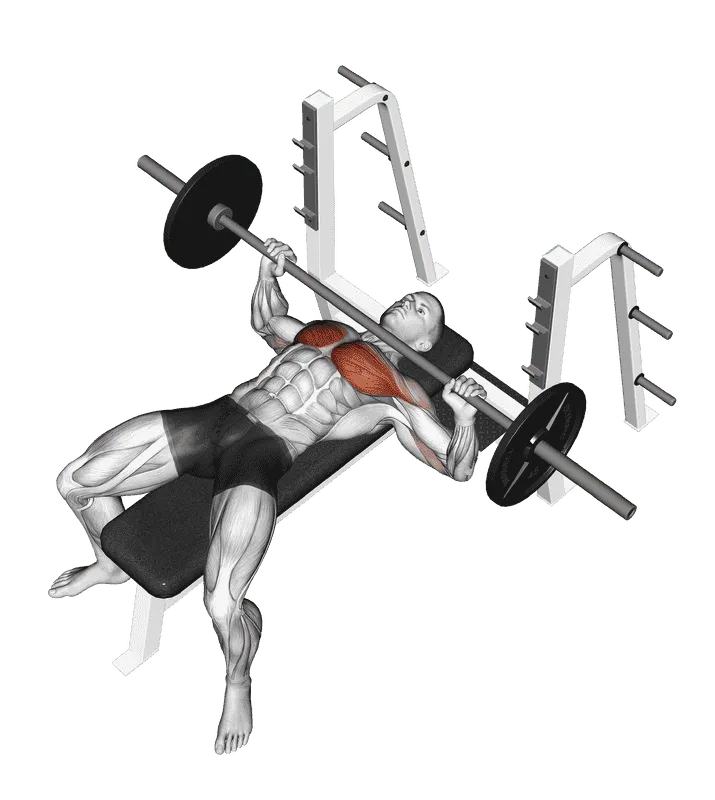
To turn a weekly number into workouts, divide it by your sessions. For example, to give your chest 12 sets a week on a four-day upper/lower split, do 6 hard chest sets on each upper day, such as 3 sets of barbell bench press and 3 sets of dumbbell incline bench press.
Short on time?
Low volume still works, just more slowly. In the 2019 study above, the one-set group trained in three sessions of about 13 minutes a week and still gained as much strength and endurance as the higher-volume groups; it simply built less muscle. If life gets busy, a few hard sets per muscle keep you progressing until you have time to do more.
How to count your sets
Only hard sets count
A set counts toward your weekly volume only if it's challenging. Growth tends to improve as sets end closer to failure,[6] but going all the way to failure isn't clearly better than stopping just short of it.[7] A practical rule: count sets that end with 0 to 3 reps in reserve (RIR), meaning you could have done at most three more reps. Warm-up sets and easy back-off sets don't count.
Count indirect sets as half
Compound exercises train more than one muscle. A bench press trains your chest directly, but also your triceps and front delts. The 2026 analysis compared three ways of counting such indirect sets: as a full set, as half a set, or not at all. Counting them as half a set predicted muscle growth best.[4]
Here's how a simple upper-body workout adds up with that method:
| Exercise | Sets | Chest | Back | Front delts | Triceps | Biceps |
|---|---|---|---|---|---|---|
| Barbell bench press | 4 | 4 | – | 2 | 2 | – |
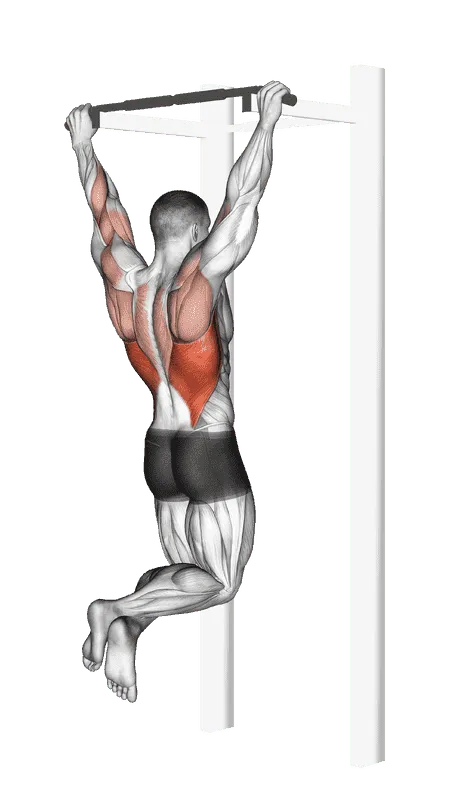
| Pull-up | 4 | – | 4 | – | – | 2 |
| Barbell standing military press | 3 | – | – | 3 | 1.5 | – |
| Barbell curl | 3 | – | – | – | – | 3 |
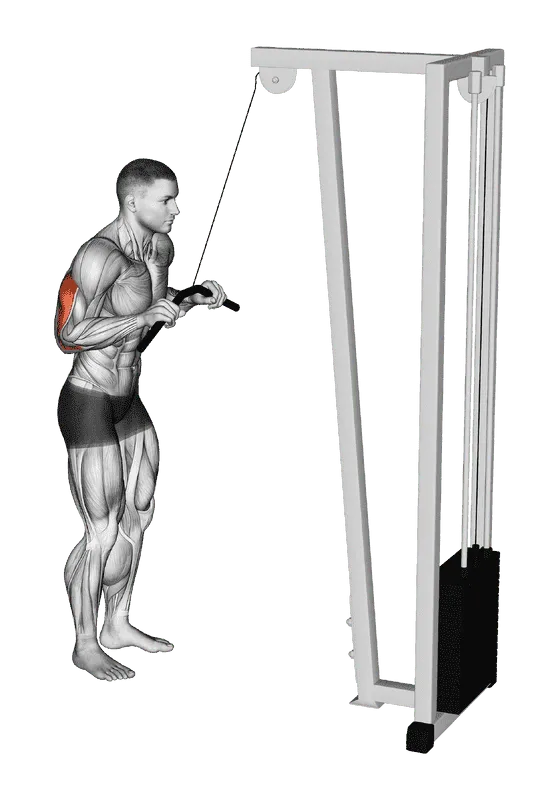
| Cable pushdown | 3 | – | – | – | 3 | – |
| Total | 17 | 4 | 4 | 5 | 6.5 | 5 |
Do this workout twice a week and your chest and back get 8 hard sets each, while your triceps get 13. If your chest were lagging, the fix would be more chest sets, not more arm work.
How to find your number
- Start at the low end of the range for your experience level.
- Track your performance for four to six weeks: the loads and reps on your main exercises.
- If you're still progressing, keep the volume where it is. There's no reward for doing more work than you need.
- If you've stalled but recover well, add two to four sets per muscle per week, usually one extra set per session.
- If your performance drops, your joints ache or your sleep suffers, cut back or take a lighter week.
This is progressive overload applied to volume. Our guide to progressive overload covers the other ways to keep progressing.
Signs your volume is off
You can probably handle more if you recover fully between sessions, your lifts keep climbing without much strain, and a muscle you want to grow still hasn't changed after a few months of consistent training.
You're probably doing too much if your performance drops across several sessions, you stay sore for days, your joints ache, or your sleep and motivation start to slide. Cut your sets by about a third for a week or two, then build back up more gradually. If joint pain doesn't settle once you cut back, see a doctor or physical therapist.
Common volume mistakes
- Counting warm-ups and easy sets. Your log says 20 sets, but only 8 of them were hard.
- Chasing volume instead of effort. Sets that end far from failure take time and energy but build little muscle.
- Lopsided volume. Twenty sets for chest and six for back leaves your back far behind your chest.
- Copying an advanced program as a beginner. Start low and earn the higher volumes.
- Ignoring indirect volume. Heavy pressing already gives your triceps plenty of work.
Frequently asked questions
Frequently asked questions
Is 10 sets per muscle per week enough?
For most beginners and many intermediate lifters, yes. It's a solid starting point at the lower end of the range that most research supports.
Can you do too many sets?
Yes. The returns shrink as volume rises, while fatigue keeps climbing. If your performance drops for a couple of weeks or your joints ache, you're probably doing more than you can recover from.
Do warm-up sets count toward weekly volume?
No. Only count sets that end within about three reps of failure. Warm-ups prepare you for those sets but aren't hard enough to drive growth on their own.
Is it better to do all my sets for a muscle in one workout?
When weekly volume is the same, frequency makes little difference, but splitting the sets over two or more sessions keeps each one higher quality. Most people find 6 to 10 hard sets per muscle per session plenty.
Should every muscle get the same number of sets?
Not necessarily. Muscles that get a lot of indirect work, like the triceps and front delts, often need fewer direct sets, while lagging muscles can get a few more.
Sources
- Schoenfeld BJ, Ogborn D, Krieger JW. Dose-response relationship between weekly resistance training volume and increases in muscle mass: a systematic review and meta-analysis. Journal of Sports Sciences. 2017. pubmed.ncbi.nlm.nih.gov/27433992/ ↩
- Schoenfeld BJ, Contreras B, Krieger J, et al. Resistance training volume enhances muscle hypertrophy but not strength in trained men. Medicine and Science in Sports and Exercise. 2019. pubmed.ncbi.nlm.nih.gov/30153194/ ↩
- Baz-Valle E, Balsalobre-Fernández C, Alix-Fages C, Santos-Concejero J. A systematic review of the effects of different resistance training volumes on muscle hypertrophy. Journal of Human Kinetics. 2022. pubmed.ncbi.nlm.nih.gov/35291645/ ↩
- Pelland JC, Remmert JF, Robinson ZP, Hinson SR, Zourdos MC. The resistance training dose response: meta-regressions exploring the effects of weekly volume and frequency on muscle hypertrophy and strength gains. Sports Medicine. 2026. pubmed.ncbi.nlm.nih.gov/41343037/ ↩
- Schoenfeld BJ, Grgic J, Krieger J. How many times per week should a muscle be trained to maximize muscle hypertrophy? A systematic review and meta-analysis of studies examining the effects of resistance training frequency. Journal of Sports Sciences. 2019. pubmed.ncbi.nlm.nih.gov/30558493/ ↩
- Robinson ZP, Pelland JC, Remmert JF, et al. Exploring the dose-response relationship between estimated resistance training proximity to failure, strength gain, and muscle hypertrophy: a series of meta-regressions. Sports Medicine. 2024. pubmed.ncbi.nlm.nih.gov/38970765/ ↩
- Refalo MC, Helms ER, Trexler ET, Hamilton DL, Fyfe JJ. Influence of resistance training proximity-to-failure on skeletal muscle hypertrophy: a systematic review with meta-analysis. Sports Medicine. 2023. pubmed.ncbi.nlm.nih.gov/36334240/ ↩